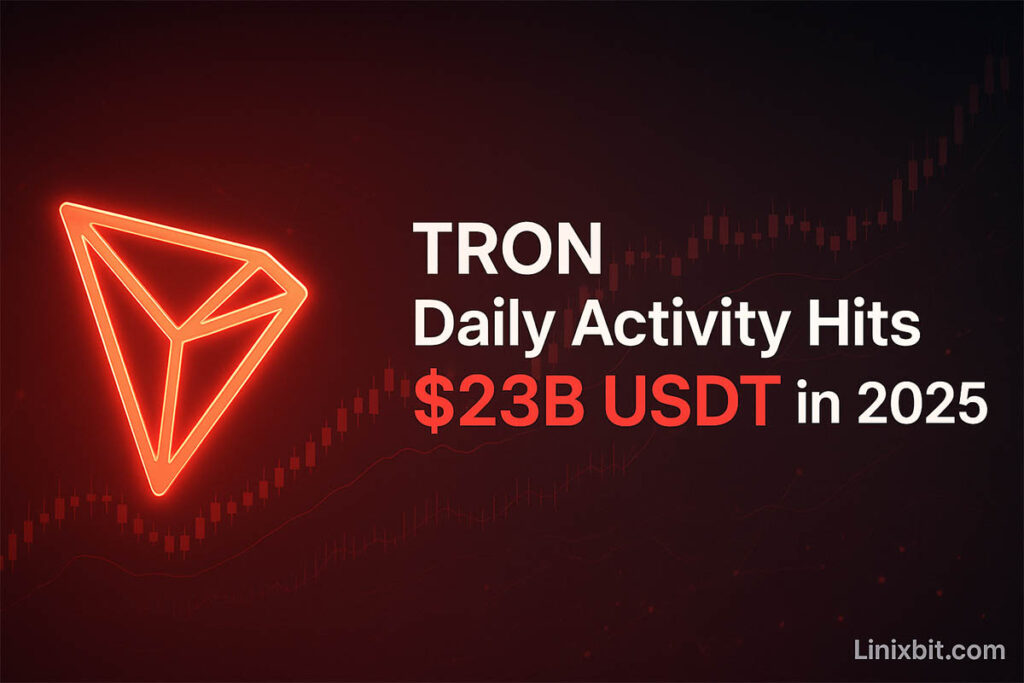
New research from CryptoQuant reveals TRON has established itself as the foremost blockchain network for payments with Tether (USDT) leading the way. The daily TRON USDT volume reached $23.4 billion in 2025 and now surpasses Ethereum by a wide margin. The growing TRON stablecoin dominance becomes clear through this shift which results from its outstanding performance and worldwide user reach.
TRON’s low transaction fees combined with fast settlement times and significant global market appeal has driven activity growth especially in emerging economies where cost-effectiveness matters most. By processing more than 283 million USDT transfers in 2025 TRON has secured its dominant position in stablecoin infrastructure while transforming the global payment structure and reshaping the cryptocurrency field.
TRON’s Tether Takeover: USDT Supply Shifts Dramatically
The stablecoin market sees a major shift when TRON takes control of the largest Tether (USDT) supply. According to CryptoQuant’s recent analysis TRON now maintains a USDT supply of $75.8 billion which fuels its exceptional TRON USDT volume surpassing Ethereum’s figures. TRON has achieved a critical breakthrough by controlling over half of the entire USDT supply.
TRON experienced a substantial 27% growth in USDT supply during 2025, which translated to a $16 billion increase. The current market status shows that Ethereum controls less than half the share, with approximately 49%, while maintaining the TRON stablecoin dominance, as other blockchain networks together represent only 1.5%. The data demonstrates a rising preference for TRON among users and developers who conduct Tether transactions.
TRON for Payments, Ethereum for DeFi Applications
The daily TRON USDT volume achieved a new record high of $23.4 billion in 2025 which demonstrates TRON’s growing market dominance. The daily transaction volume on TRON currently stands more than double Ethereum’s average of $10.5 billion which saw a 37% drop from its highest point reached in late 2024. The increasing difference in transaction volumes between the two networks demonstrates their shifting primary applications.
The market shows a pattern where Ethereum is becoming the preferred platform for advanced decentralized finance (DeFi) protocols alongside institutional applications. TRON continues to establish itself as a top crypto payment solutions for high-volume retail transactions. The combination of fast processing and low cost positions TRON as the perfect option for routine transactions in budget-conscious settings.
TRON’s Expanding Ecosystem for Digital Commerce
The TRON network primarily operates through USDT transactions, but the growing utility of various other tokens shows how its function in decentralized finance and commerce continues to expand. The Wrapped TRX (WTRX) platform processed 2.5 million transfers, demonstrating a strong decentralized exchange (DEX) ecosystem based on the TRON blockchain that facilitates diverse financial operations beyond basic transferring tasks.
TRON’s expanding footprint in retail commerce and international remittance markets is evidenced by PayNet Coin’s 1.3 million transfers and USDD stablecoin’s 427,000 transfers. According to CryptoQuant data, TRON’s transaction volume driven by payment tokens matches its strategy of becoming a leading provider of crypto payment solutions while building an efficient payment infrastructure.
TRON’s Path Forward: Leading the Charge in Blockchain Payments
The extensive data reveals TRON’s dominant position in stablecoin transactions through its massive TRON USDT volume. TRON processes 2.4 million USDT transactions every day while Ethereum manages only 284,000 thus expanding the operational disparity between the networks which demonstrates TRON’s advanced capability for high-volume payments and confirms its leading role.
TRON achieved its success through a purposeful strategy that positions it as an efficient, high-throughput blockchain optimized for transaction speed on a low-cost basis instead of smart contract functionality. The stablecoin market recognizes this network as the leader due to its reliable performance and global reach while maintaining a strong commitment to the expanding payments sector.